Canada Posts

2006/05/29

In the Desert, Ancient Signs


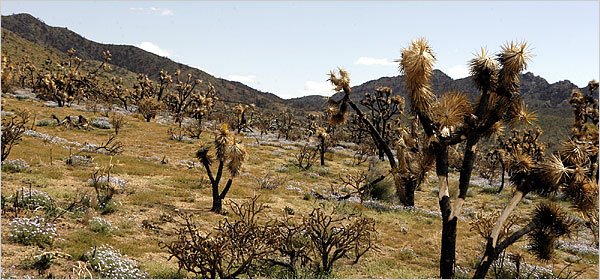
ON the northern border of a vast desert preserve, halfway up a dusty hillside and overlooking a great forest of Joshua trees, David Nichols knelt to brush off a flat gray stone.

Mojave National Preserve
"Yep, this is one right here," he said, motioning toward a sheet of exposed bedrock. A group of small, closely spaced stones, like tiny turrets in the sand, formed a vague ring at his feet. "These supposedly kept the rodents out."

Mr. Nichols, one of two full-time research archaeologists employed at Mojave National Preserve, was showing off a recent discovery. On a nondescript hill, a quarter-mile off a four-wheel-drive dirt track, the remnants of a prehistoric way of life lay scattered in the sand.Mojave National Preserve

Throughout Mojave National Preserve, a 1.6 million-acre park about 140 miles northeast of Los Angeles, the subtle traces of a bygone civilization are all around. Pictographs painted on cave walls, dart tips in the sand, shelters, fire rings and pottery shards are common in the area, where generations of prehistoric people lived and died. Indeed, Mojave National Preserve is an amateur archaeologist's dream, with undocumented sites open year-round for visitors to explore in the empty, undeveloped park.


More of this : In the Desert, Ancient Signs

2006/05/04

7000-Year-Old Mass Grave Discovered in Bolaghi Gorge


Archeological excavations in Bolaghi Gorge historical site led to the discovery of the remains of three skeletons dating back to 5000 BC in a single grave in the area number 131 at the closest point to the Sivand Dam which will be flooded by mullahs soon.

"Existence of three skulls and disordered bones shows that it must have been a mass grave. The discovered clays in this grave indicate that the skeletons found here belong to the Bacon era (fifth to fourth millennium BC). This mass grave was discovered in area number 131 which is the closest archeological site to the Sivand Dam. Two big and two small clay dishes have also been found in this grave," said Mojgan Seyedein, Iranian head of the Iranian-German joint archeology team in Bolaghi Gorge.

Prior to this, the remains of a skeleton of a young girl belonging to the Bacon era was discovered in area number 73 also by the joint Iranian-German team. According to Seyedein, the only difference between the skeletons found recently with that of the girl is that the skeleton of the girl was discovered almost intact while the ones which were discovered in their latest excavations are fragmented.

More of this at : 7000-Year-Old Mass Grave Discovered in Bolaghi Gorge

2006/05/03

Neanderthals Lived in Iran's Kermanshah Caves


The latest excavations by Iranian and French joint team at prehistoric caves of Kermanshah, west of Iran, revealed them to have been early settlements of Neanderthals who used to live there about 85000 to 40000 years ago.

The joint team was to continue its studies on other Paleolithic caves in Kermanshah province, but as the term of the agreement has reached an end, the French team have returned back home. This team is to resume its activities in March 2006 in prehistoric caves in Kermanshah province if the agreement is renewed for an extended term.

Asadollah Piranvand, head of Kermanshah branch office of Iran's Cultural Heritage and Tourism Organization, said, "This team conducted some research in prehistoric caves of the province in March 2005, which revealed these caves to be early settlements of Neanderthals about 85000 to 40000 years ago."

Neanderthals Lived in Iran's Kermanshah Caves

2006/03/30

On behalf of the CAA 2006 Organising Committee, I cordially invite you to the 39th annual meeting of the Canadian Archaeological Association in Toronto from May 24th-27th, 2006. Our venue is the University of Toronto's residence and conference facility, 89 Chestnut. As both a place to stay and a place to meet, this facility is first rate. You can see this for yourself by visiting the 89 Chestnut web site.

Several special events are being planned in conjunction with the conference. Participants will be able to visit local museums and archaeological sites around Toronto, and you can count on receptions and a banquet that will be up to the high standards set by recent meetings. Speaking of the banquet, an annual CAA tradition, this year we will meet in the Lakeview Room on the 27th floor of 89 Chestnut. As the name implies, this room provides a spectacular view of downtown Toronto and the lakefront district, including City Hall and the CN Tower. It certainly promises to be a memorable night!

Link to web site :
Welcome to the 39th Annual CAA/ACA Conference Website

2006/03/24

Bangladeshi archaeologists discover ancient fort city


WARI, Bangladesh: Archaeologists in Bangladesh say they have uncovered part of a fortified citadel dating back to 450 BC that could have been a stopping off point along an ancient trade route.
So far, a moat round the citadel has been uncovered along with parts of an ancient road at Wari, 85km northeast of the capital Dhaka.
Link to this:

Gulf Times - SriLanka/Bangladesh


Reuters UK

2006/03/11

Artifacts reveal distant past


EASTHAM - It's been 16 years since Frederica Dimmick, the National Park Service archaeologist at the Cape Cod National Seashore, first saw the little hearth area with blackness all around it.
More:Artifacts reveal distant past

2006/03/06

Archaeology in Arctic North America


The northernmost part of the North American continent has seen some of the most fascinating human adaptations anywhere, extending back thousands of years. But learning about those adaptations through archaeological research in that vast region presents a number of unique challenges, including short field seasons, immense logistical problems, and excavation into permafrost (permanently frozen ground). Using text and images, these pages provide a glimpse of archaeological research in this region and its results focusing principally on the Canadian Arctic where I've done the majority of my research.

Link to this:Arctic Archaeology

2006/02/12

Museum digs into prehistory


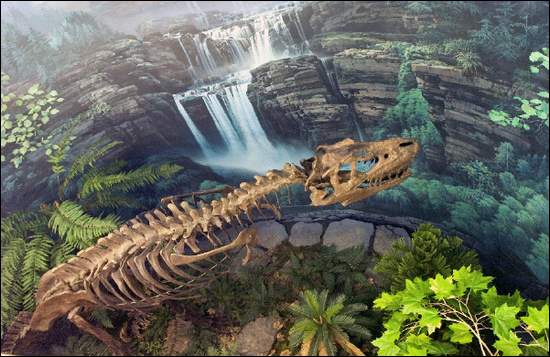
Rochester Museum & Science Center and its newly installed exhibit, "Expedition Earth: Glaciers & Giants." It flash-freezes 200 million years of western New York history ? including a flesh-eating Albertosaurus, a shaggy mastodon and towering blue glaciers.
The Albertosaurus


The Albertosaurus skeleton in the exhibit is placed in a setting that evokes the environment the predatory dinosaur inhabited about 75 million years ago.

More on this Exhibit:Expedition Earth: Glaciers & Giants.

Online Resources for Canadian Heritage


Archaeology in Canada


For a list of Institutions and Associations in Archaeology in Canada go at this link : Archaeology - Canada


And for the Parks Canada Agency:Archaeology at Parks Canada


See you then !

2006/01/22

"Ancient lakes of the Sahara"


The Sahara has not always been the arid, inhospitable place that it is today ? it was once a savannah teeming with life, according to researchers at the Universities of Reading and Leicester.

In their article ?Ancient lakes of the Sahara?, which appears in the January-February issue of American Scientist magazine, Dr Kevin White of the University of Reading and Professor David Mattingly of the University of Leicester explain how they used satellite technology and archaeological evidence to reveal new clues about both the past environment of the Sahara and of human prehistory in the area.

?The climate of the Sahara has been highly variable over the millennia and we have been able to provide much more specific dating of these changes,? said Dr White. ?Over the last 10,000 years, there have been two distinct humid phases, separated by an interval of highly variable but generally drying conditions between roughly 8,000 and 7,000 years ago. Another drying trend took place after about 5,000 years ago, leading to today?s parched environment.
Full article:
Ancient lakes of the Sahara:

2006/01/14

"Mongolia looks to archaeologists and dinosaur hunters to help create jobs"


BAGA GAZRYN CHULU, Mongolia (AP) Archaeologists and dinosaur hunters are digging up Mongolia's vast countryside, seeking to retrace thousands of years of history in this storied but still mysterious land.


It was from here that Genghis Khan's armies conquered China and threatened Europe some 700 years ago, and where untold herds of dinosaurs once roamed.

To the newswire:
Mongolia looks to archaeologists

2006/01/03

Storm brews over treasures sunk in 1814


HALIFAX -- A U.S. treasure hunter's bid to scavenge a famed War of 1812-era shipwreck off the coast of Nova Scotia has met a storm of protest from underwater experts, who say the province's rich maritime history is being pillaged by modern-day pirates.

HMS Fantome was laden with loot believed to have been stolen from Washington -- including from the White House and Capitol building -- when it ran aground on a treacherous shoal south of Halifax in November, 1814. The crew of the British naval vessel survived, but its cargo was lost to the stormy sea.

Now, a Pennsylvania-based treasure hunter has obtained a licence from the Nova Scotia government to excavate what is believed to be the wreck site, a move that has angered divers and underwater archeologists who say the ship's bounty could include priceless historical artifacts, which should not be sold for profit.


Storm brews over treasures sunk in 1814

2006/01/02

World at its Hottest Since Prehistory


Scientists in Bern, Switzerland, and Oregon analyzed levels of the gas in tiny air bubbles trapped in Antarctic ice during the past 650,000 years. They found current levels were 27 percent greater than the highest level over that period. The UK's Chief Scientist said the last time levels of the gas were that high was 60 million years ago.

World at its Hottest Since Prehistory  Posted by Picasa

Is the little levity can wait until we're all not busy ?


It's been a Canadian tradition for almost 400 years for levees to be held Jan. 1, according to history books.

The first recorded event was in 1646 in Chateau St. Louis by the Governor of New France, which later became Quebec. Citizens came with well wishes and to hear news from overseas.

The ritual was carried on by British colonial governors, then governor generals and eventually down the line to mayors and councillors.

The word levee itself comes from the French word lever, meaning to rise. It started with King Louis XIV back in the 1600s, who made a habit of receiving his subjects in his bed chamber just after he woke. Levees developed to become a vital means of spreading information.

Now more like a reception, New Year's levees are still popular across the country. Mayors in Toronto, Mississauga, London, Ottawa, Montreal, Quebec and Waterloo will all be shaking hands.

"The other side of a traitor


Tom Desjardin is tackling an American legend with his latest book.

Desjardin, a Maine native with a Ph.D. in U.S. history, has written a book about some of the good things Benedict Arnold did during the American Revolution before becoming our country's most famous traitor.

Desjardin has written "Through A Howling Wilderness - Benedict Arnold's March to Quebec, 1775." The book details Arnold's leading 1,100 soldiers on a secret mission through Maine to seize British Quebec.

Desjardin, 41, is originally from the Lewiston/Auburn area and now lives in Pittsfield. He works as a historic site specialist for the state of Maine and has written four books.
The other side of a traitor:
"

2005/11/27

Site May Be 3rd-Century Place of Christian Worship


By Scott Wilson
Washington Post Foreign Service
Monday, November 7, 2005; Page A14

MEGIDDO, Israel, Nov. 6 -- Israeli state archaeologists have discovered mosaics, pottery and other remains of a Roman-era Christian building on the grounds of a high-security prison here. They say the site could be the oldest public place of Christian worship ever uncovered in Israel and perhaps one of the earliest such sites in the world.

The mosaic floor of the structure, buried beneath rock, soil and asphalt, was discovered Oct. 30 by an Israeli prisoner working on behalf of the Israel Antiquities Authority. The agency has been excavating the compound for more than a year to ensure that nothing of historic value is lost during an ongoing renovation project. At a news conference Sunday, Yardena Alexandre, a spokeswoman for the authority, called the discovery "one of the most important finds for the history of early Christianity."

Follow this:
Site May Be 3rd-Century Place of Christian Worship

Indian art rediscovered in upstate New York


The Canadian high school archaeology teacher had rediscovered a rare example of Indian rock art long thought to have been erased by centuries of weathering. Scardera reported his find for the first time this fall at the Conference on Iroquois Research at The Rensselaerville Institute Conference Center.

The red ochre-streaked rock face was last recorded in a 1920 photograph kept by the New York State Museum in Albany.


Indian art rediscovered in upstate New York

"French, Canadians to explore Mazandaran caves"


LONDON, November 20 (IranMania) - Scholars from Lyon and Toronto Universities have asked to carry out excavations in the ancient caves of Mazandaran province in Iran, CHN reported.

Previous studies and excavations in the caves indicate that human settlement in Mazandaran province dates back to 40,000 years ago.

Mazandaran province, in the southern coastal line of the Caspian Sea, enjoys several unique caves such as Kushiman. Mazandaran is one of the most historical provinces of Iran, the inhabitants of which have lived in urbanized societies from the 5th millennium BC. Until now a lot of mysteries of the 5,000-year-old life of the people of the region have been revealed.


Iran News - French, Canadians to explore Mazandaran caves:

2005/11/06

Digging into the past


Once a monastery, later Army barracks, and today the site of a future shopping mall, the northeast quadrant of what is now námestí Republiky has always reflected the changing face of Prague. During the initial stages of the ongoing construction of the 7.5 billion Kc ($303 million) Palladium shopping center project, archeologists have discovered the remnants of yet another era: the foundations of a 12th-century Romanesque palace.

The European Property Fund (EPF), the project's investor, has spent 100 million Kc on the archeological excavation. This is a requirement stipulated by law: Any investor planning construction in a historical area must first do an archeological survey of the site, and if archeological artifacts are found, he must finance further fieldwork.

More of this:

The Palladium site yields an unexpected bounty of archaeological treasure


2005/10/23

Course Catalog
Out of the Cave: Prehistory in Fact and Fiction


Short story:
Out of the Cave: Prehistory in Fact and Fiction"